Mr Mad Soudar
©

Mr Mad Soudar

|

Mr & Mad Soudar

Professional let-out-to-tourists of furnished accommodation All the information you need

Do you own a flat, a house or a studio that you’d like to offer for holiday lets within
Pau Béarn Pyrénées conurbation?
Pau Pyrénées Tourisme is here to support you through the process and help you develop your business.

What is a holiday let?

A furnished holiday let is a furnished house, flat or studio offered for the exclusive use of temporary guests who do not take up residence there.

The property may be let by the night, by the week or by the month. However, the same guest may not occupy the property for more than 90 consecutive days in any one calendar year.

The accommodation must be equipped to enable the tenant to stay there independently: furniture, bedding, kitchen equipment, a fridge, etc.
Worth noting

The self-catering accommodation must not exceed a capacity of 15 people.

If it exceeds this number, your accommodation falls into the category of ‘Establishments Open to the Public’ (ERP), which are subject to specific and relatively complex regulations, particularly in terms of fire safety and accessibility.

Caution! Do not confuse furnished accommodation with guest rooms

A guest room is a furnished room in a private home intended to accommodate tourists, for a fee, for one or more nights, together with certain services.

It also involves the provision of services: cleaning the room, providing breakfast and linen, and welcoming guests by the owner.

A declaration of guest room rental must be submitted to the town hall using Cerfa form No. 13566*03.

Accommodation capacity is limited to five rooms and 15 people.


To get your business off the ground

1. Register your holiday let

Before starting your business, you must complete the registration procedures for your holiday let.

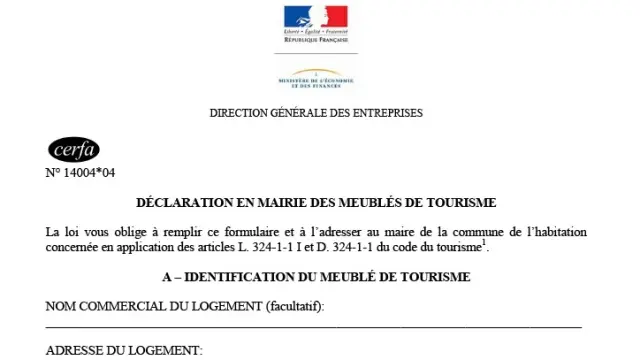
Currently, within the Pau Béarn Pyrénées urban area, registration is carried out at the town hall of the municipality where the property is situated, using the Cerfa form no. 14004*04 – Registration of holiday lettings at the town hall.

Are you letting out your main residence?
Tourist letting of this property is limited to 120 days per calendar year; however, a local council may decide to reduce this limit to 90 days.

Important A new procedure Coming soon

A national online registration service for holiday lettings is set to replace this procedure in the long term.
Its launch, originally scheduled for the first half of 2026,
has now been announced by the Directorate-General for Enterprise for the fourth quarter of 2026.

Once this online service is operational, landlords will be required to
register their holiday lettings with it in order to obtain a registration number.

For the time being, please continue to submit your declaration in accordance with the procedure currently in force in the country.
Information updated in September 2026

______________

Following the publication of the LE MEUR–ECHANIZ Act and its implementing decrees, regulatory requirements are changing.
Take part in this workshop to find out about the practical implications for your rental property and the steps you need to take.
A practical session to help you prepare calmly for the changes ahead.

2. Register the start of your business And obtain a SIRET number

The letting of a furnished holiday let must be declared upon commencement of the business.
This must be done within 15 days of starting the business, via the one-stop shop for business formalities.

In particular, this enables you to:

  • To obtain your SIRET number
  • To officially register your business
  • To specify your chosen tax regime

3. Collect And declare the tourist tax

The Pau Béarn Pyrénées Urban Community has introduced a tourist tax across its entire territory.
It applies to all tourist accommodation located in the 31 municipalities of the urban community.

The amount of the tourist tax is decided locally by council resolution. The rate depends, in particular, on whether your self-catering accommodation is classified or not.
For unclassified self-catering properties, the tax is calculated as a proportion of the price per night.
To find out the exact amount to be charged, use the platform’s calculator directly.

In all cases, an account will be created for you, giving you access to the dedicated platform.

Your contact Regarding the tourist tax

Pau Pyrénées Tourism
Laëtitia Sabourault
Tourist Tax Revenue Office
Place Royale – 64000 Pau
Tel.: 05 59 27 27 08
Email: [email protected]

4. Taxation of your holiday let

Income from letting a furnished holiday let is taxable and must be declared each year. It falls under the category of industrial and commercial profits (BIC).

Good to know:
The classification also has tax implications. Under the micro-BIC scheme, a classified holiday let benefits from a higher income threshold and a flat-rate allowance of 50 per cent, compared with 30 per cent for an unclassified holiday let.
View the 2026 tax rules on Service-Public.fr

Other contributions may apply
Your furnished letting business may be subject to other charges or contributions, in particular the Business Property Tax (CFE) or, depending on your income and circumstances, social security contributions.

The rules and any exemptions depend on individual circumstances.
To find out whether this applies to you, please contact your Business Tax Office (SIE) and Urssaf.

5. Having your holiday let classified A proactive approach

Like hotels and campsites, self-catering holiday accommodation can be awarded an official star rating of between 1 and 5 stars.

The classification is voluntary and is based on a national set of criteria covering, in particular, facilities, services offered, accessibility and initiatives promoting sustainable development.

It is awarded for a period of 5 years.

Why have your holiday let classified? 

In particular, the ranking enables you to:

  • Reassure your future customers with an official guarantee of comfort and quality
  • Set your accommodation apart from the competition
  • Benefit from more favourable tax treatment under the micro-BIC scheme
  • Benefit from a fixed tourist tax rate, unlike unclassified self-catering accommodation, which is subject to a proportional rate

Pau Pyrénées Tourisme supports letholders and carries out the classification of holiday let properties directly

So you don’t forget anything The little extras... Tips and advice

Get your holiday let ready

Before letting out your furnished property, remember to check a few key points:

  • Your insurance and the cover provided for holiday lettings
  • The owners’ association rules, where applicable, and information from the property manager
  • Change of use: At present, there are no regulations governing changes of use within the Pau Béarn Pyrénées area
  • Mandatory safety equipment
Welcome your visitors

A warm welcome plays a direct part in your customers’ satisfaction and in the destination’s image.
A few simple touches can make all the difference:

Boost the visibility of your accommodation

Pay particular attention to:

  • Your photos: Choose bright photos that show the property to its best advantage
  • Your description: Clearly outline the facilities, capacity, location and key features of your accommodation
  • Your practical information: Check-in and check-out times, parking, transport, facilities, accessibility, house rules, etc.
  • Your online reputation: Keep an eye on the reviews left by your guests and take the time to reply to them

Offer a more sustainable furnished property

There are also a few simple steps you can take to reduce the environmental impact of your business:

  • Limit water and energy consumption (install water flow restrictors, LED lighting, etc.)
  • Opt for more energy-efficient equipment
  • Make it easier to sort waste
  • Use eco-friendly and reusable products wherever possible
  • Inform visitors about public transport and sustainable travel options
  • Prioritise local products for any welcome gifts you may provide
  • These measures help both to reduce your energy consumption and to meet visitors’ growing expectations regarding sustainable tourism
Enhance the value of your accommodation with a quality mark

A quality mark helps to highlight a particular commitment, quality or positioning of your accommodation. It can also help you stand out from the crowd and better meet the expectations of certain customer groups.

There are numerous labels available depending on your approach; here are a few:

It’s up to you to choose the approach that best suits your accommodation and the guests you wish to welcome.

Professional let-out-to-tourists of furnished accommodation FAQ All the information you need

Elsewhere in Béarn You will also like...